
Everest Teamwork and Leadership Simulation
Explore group dynamics and leadership training in the context of climbing Mount Everest
Simulation Overview
In this leadership and teamwork simulation from Harvard Business Publishing, participants explore group dynamics and leadership in the context of climbing Mount Everest. Each round of the simulation lets players analyze information on speed, health, weather conditions and supplies before making decisions. The learners will also decide how to effectively share their information and decisions with their teammates. This Harvard team simulation is played synchronously with teams of 5. It can be played asynchronously between multiple teams.
- Bullet point testing
- Bullet point testing
- Bullet point testing
Players

Multiplayer
Languages

English, French, Spanish, Portuguese, Japanese, Chinese, Arabic
Simulation Time

Total Time: 3-4 Hours
Intro 30, Gameplay 60-90, Debrief 45-60
Accessibility

WCAG 2.2 Compliance
Price

$165 per person
Simulation Categories

The Story
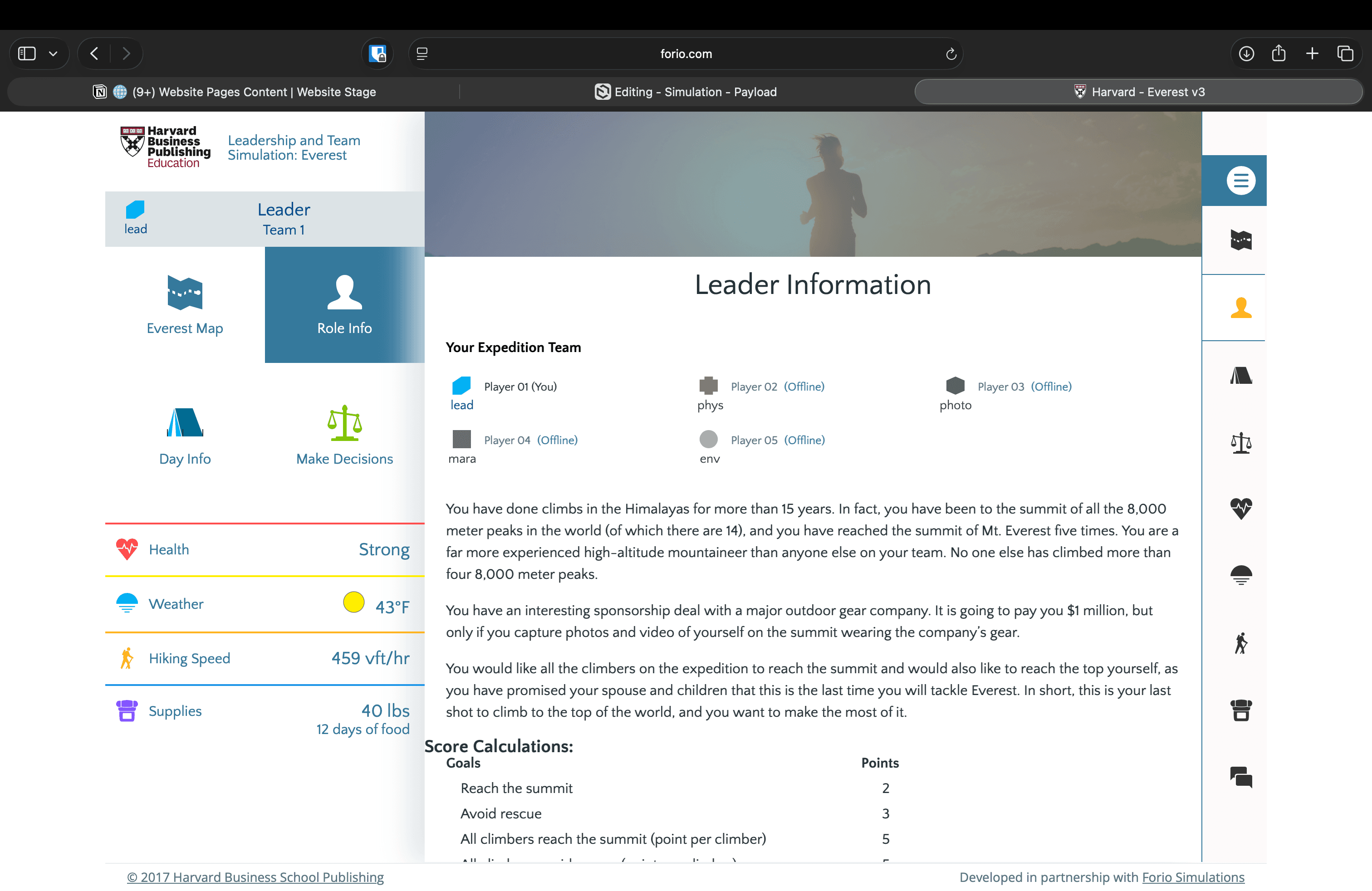
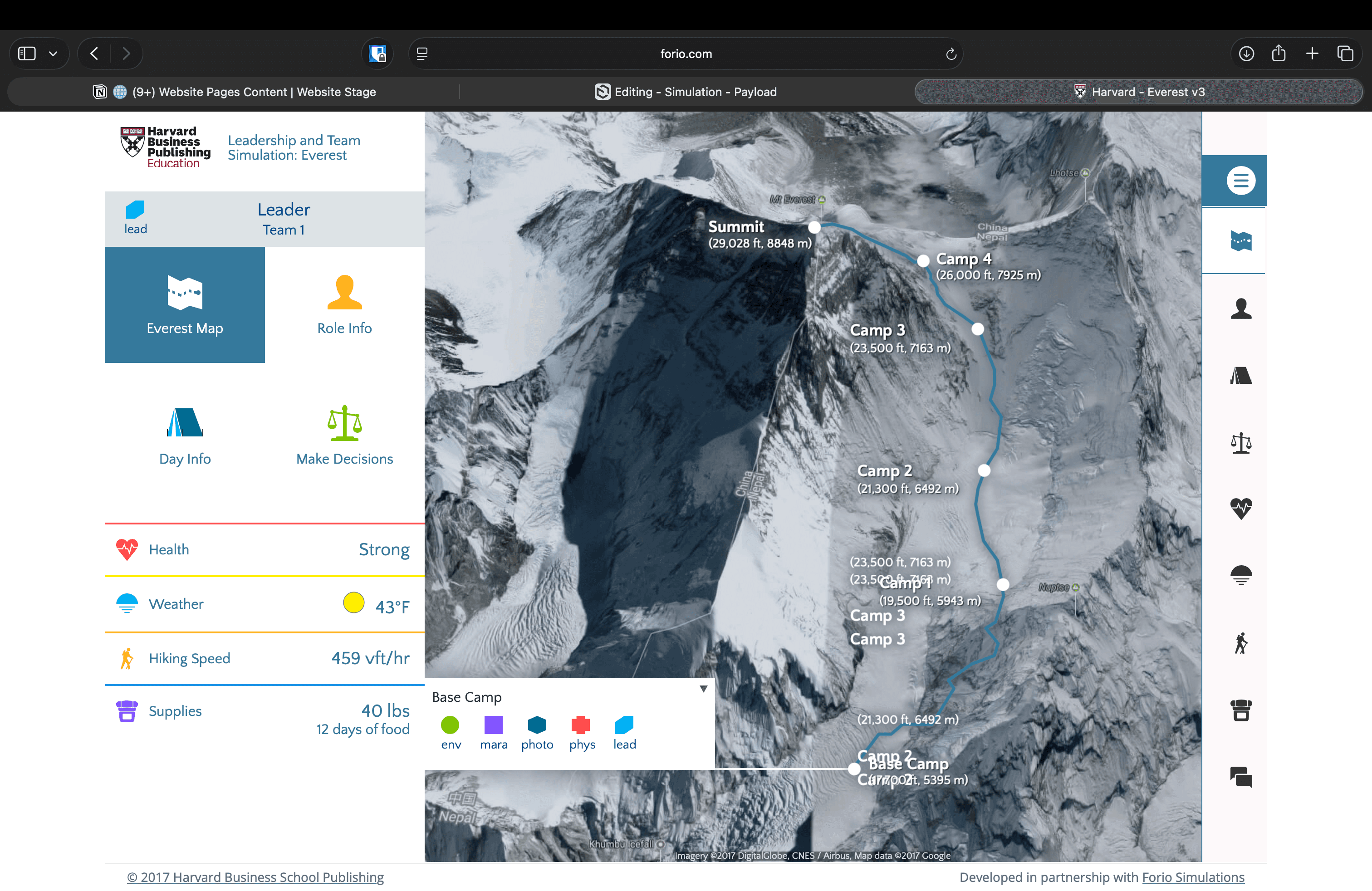
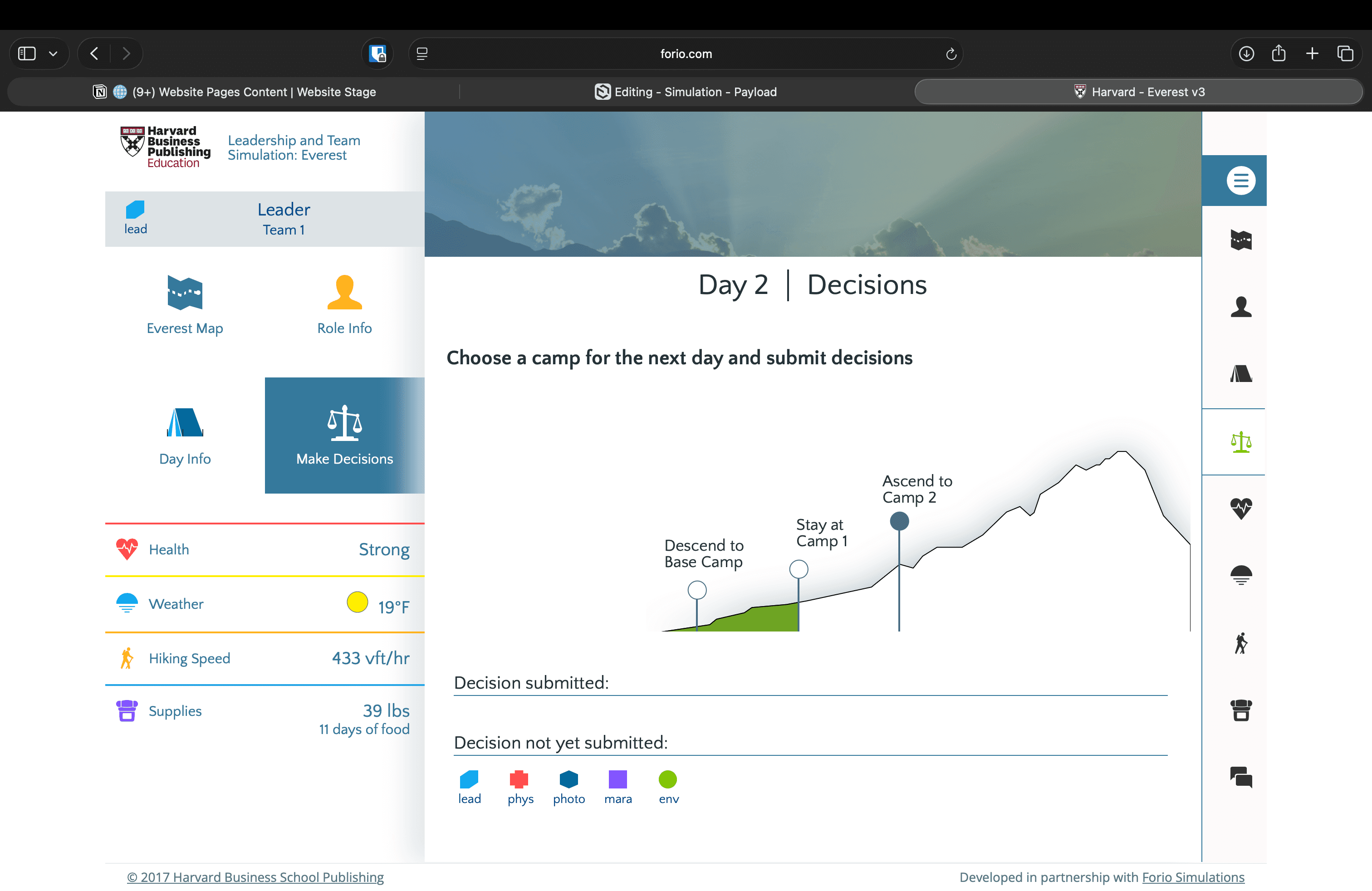
Participants of the Mount Everest simulation course play one of five team members attempting to summit Mount Everest in this collaborative, multi-player simulation. During each round of play, team members analyze information on weather, health conditions, supplies, goals, or hiking speed, and determine how much of that information to communicate to their teammates. Failure to accurately communicate and analyze information has consequences on team performance.
During the 6 simulated days of hiking the mountain, the teams face various challenges individually. They also face three hidden challenges as a team and have to collaborate to figure out how to overcome these challenges.
- Bullet point testing
- Bullet point testing
- Bullet point testing
Core Competencies
Clear Communication
Information Sharing
Collaboration
Cross Functional Alignment
Conflict Resolution
Effective Teamwork
Building Strong Teams
Negotiation and Tradeoffs
Learning Objectives
Resources to Power Your Simulation
Each simulation comes with a Teaching Guidebook for the facilitator, along with 1:1 facilitator training and free trials.
Available with this simulation
Quick Start Guide

Facilitation Guide
Debrief Slides
Intro Slides
Author Video
Facilitator Video
Free Trial & Demo
Check Out Similar Forio Sims
Leadership and Teamwork
Easy Meals

In this leadership and communication simulation for executives, learners will act as the executive senior leadership team of a meal kit company called Easy Meals. Learners respond to crises occurring in each round by making decisions both individually as executives and as a team. While they are facing different challenges throughout the simulation, learners will practice effective and consistent communication with different stakeholders, evaluate trade-offs, and seek consensus with teammates about decisions. This is a multiplayer simulation with teams of 5 or 6.
Check It Out
Leadership and Teamwork
Group Communication & Decision Making Simulation
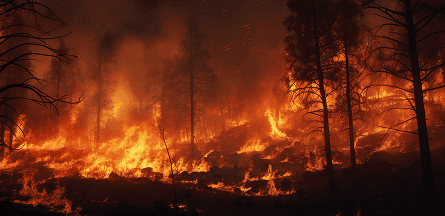
Communication and Decision Making Simulation Overview The Group Communication and Decision-making simulation requires players to balance their interests, the interests of their constituents, and their team members to create a wildfire mitigation plan
Check It Out
Leadership and Teamwork
Leading Teams that Deliver

This simulation teaches essential leadership skills to learners without the need for a facilitator, allowing learners to complete the simulation asynchronously and whenever their schedule allows.
Check It Out